News
The End of Static Offices
Mar 25, 2026

Georgiana Floroiu
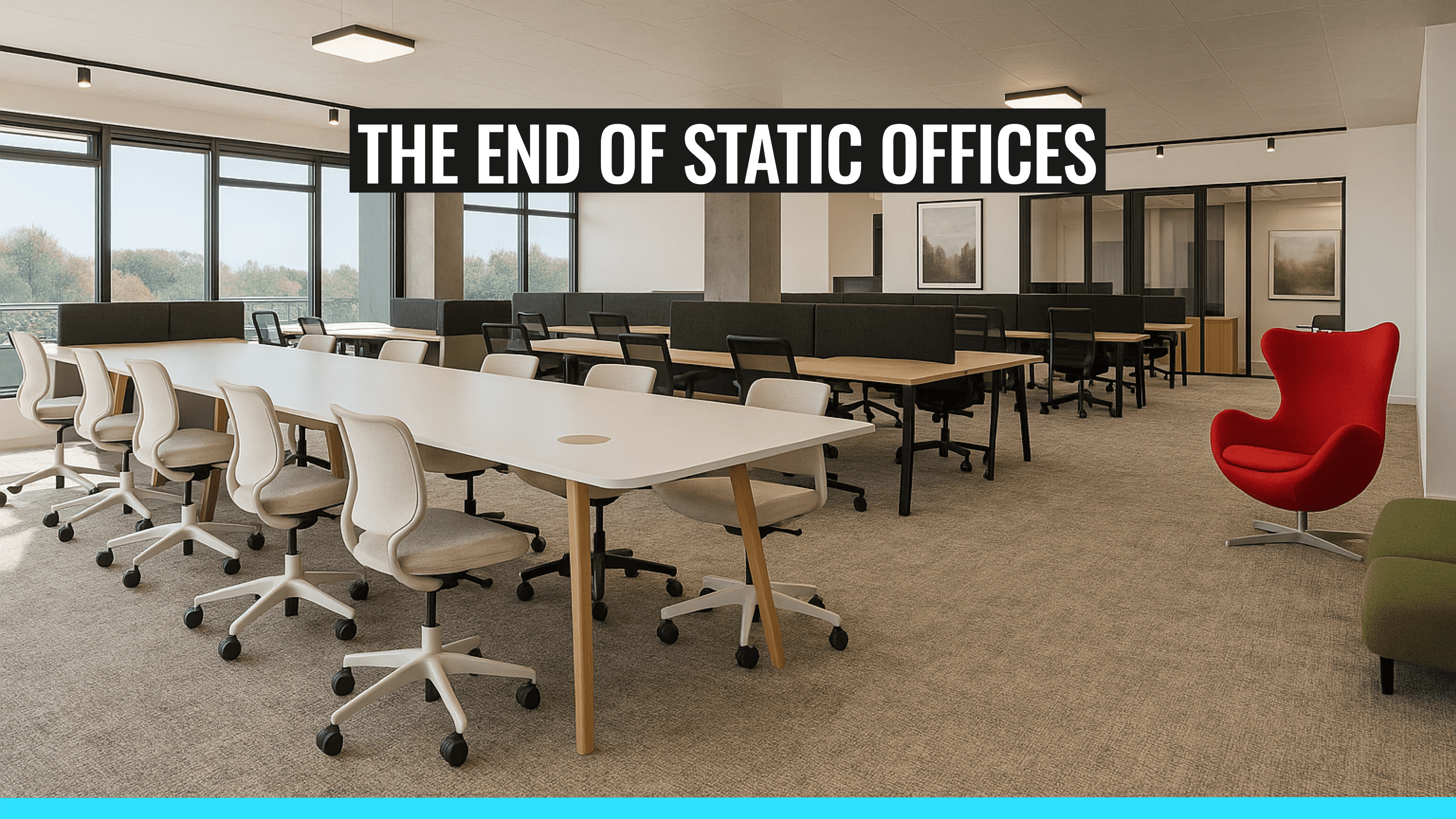
For years, the office was treated as a statement.
Companies invested heavily in flagship, highly customised spaces designed to reflect their identity. These environments were carefully planned, expensive to build, and expected to remain relevant for years. Once delivered, they rarely changed. Layouts were fixed, decisions were locked in early, and adapting the space later often meant starting over.
That approach created impressive offices. But it also created rigidity.
It worked in a world where organisations themselves were relatively stable. Teams grew predictably, roles were clearly defined, and the way people worked did not fundamentally change from one year to the next.
That world no longer exists.
From workplace design to workplace behaviour
The next shift came with workplace strategy.
The industry moved beyond design and started analysing how people actually use space. How teams move, where they collaborate, how they focus. This brought a new level of intelligence into decision-making and helped companies move away from assumptions.
But it also introduced a limitation.
Workplace strategy assumes that behaviour can be observed and optimised over time. Today, that assumption is increasingly fragile. Teams evolve constantly. Hybrid work reshapes usage patterns from one week to the next. AI is already changing roles, workflows, and team structures.
What you analyse today may not hold true tomorrow.
The new driver: performance
We are entering a new phase where the office is no longer evaluated based on how it looks or even how it is used at a single point in time.
It is evaluated based on how it performs over time.
How easily it adapts. How efficiently it supports change. How much value it generates across its lifecycle.
This shift changes the priorities. Instead of optimising for a fixed layout, companies are starting to optimise for flexibility. Instead of focusing on upfront investment, they are looking at how space performs operationally, month after month, year after year.
Why modularity changes everything
This is where modularity becomes critical. Not as a design trend, but as an economic model.
A modular office requires more thought upfront, but it allows the space to evolve without starting from zero every time. Instead of redesigning every few years, companies can adjust layouts continuously as their needs change.
The impact is straightforward:
the cost of change decreases
adaptation becomes faster
space stays relevant for longer
Over time, this creates compounding value. The office improves not because it was perfectly designed once, but because it can continuously adapt.
The shift to office as a service
At the same time, the way office space is delivered is evolving. Traditional serviced offices introduced flexibility, but they were still largely standardised. What’s emerging now is a more advanced model, where flexibility is built into the space itself, not just the contract.
In this model, layouts adapt to the tenant, configurations evolve with the team, and the space is continuously adjusted rather than periodically redesigned. The goal is no longer to deliver space. It is to continuously deliver the right space.
What will define the office of the future
The future office will not be defined by how impressive it looks on day one. It will be defined by how well it adapts over time.
The best-performing spaces will be modular at their core, dynamic in how they function, and continuously optimised based on real needs. In a world where organisations are in constant motion, adaptability becomes the main source of value.
The missing layer: making space adaptable
To enable this shift, the industry needs more than new design principles. It needs better tools.
Managing a dynamic office with static files and slow processes creates friction. It limits how quickly decisions can be made and how often space can be improved.
This is where Intelligent 3D Space Planning becomes essential.
It allows teams to generate and test layouts quickly, visualise space in real time, align stakeholders faster, and make decisions with more clarity. Instead of treating space as a fixed asset, it turns it into a system that can evolve.
Where this is heading
The direction is already clear. The office is moving from static to dynamic, from one-time decisions to continuous optimisation, from design-led thinking to performance-driven thinking.
This shift is not about aesthetics. It’s about efficiency, adaptability, and long-term value. The companies that understand this early will not just have better offices. They will operate better.
And in a world where everything changes faster, that difference compounds.