How AI Supports Valuation, Optimization, and Tenant Decisions at IULIUS
Apr 23, 2026

Georgiana Floroiu
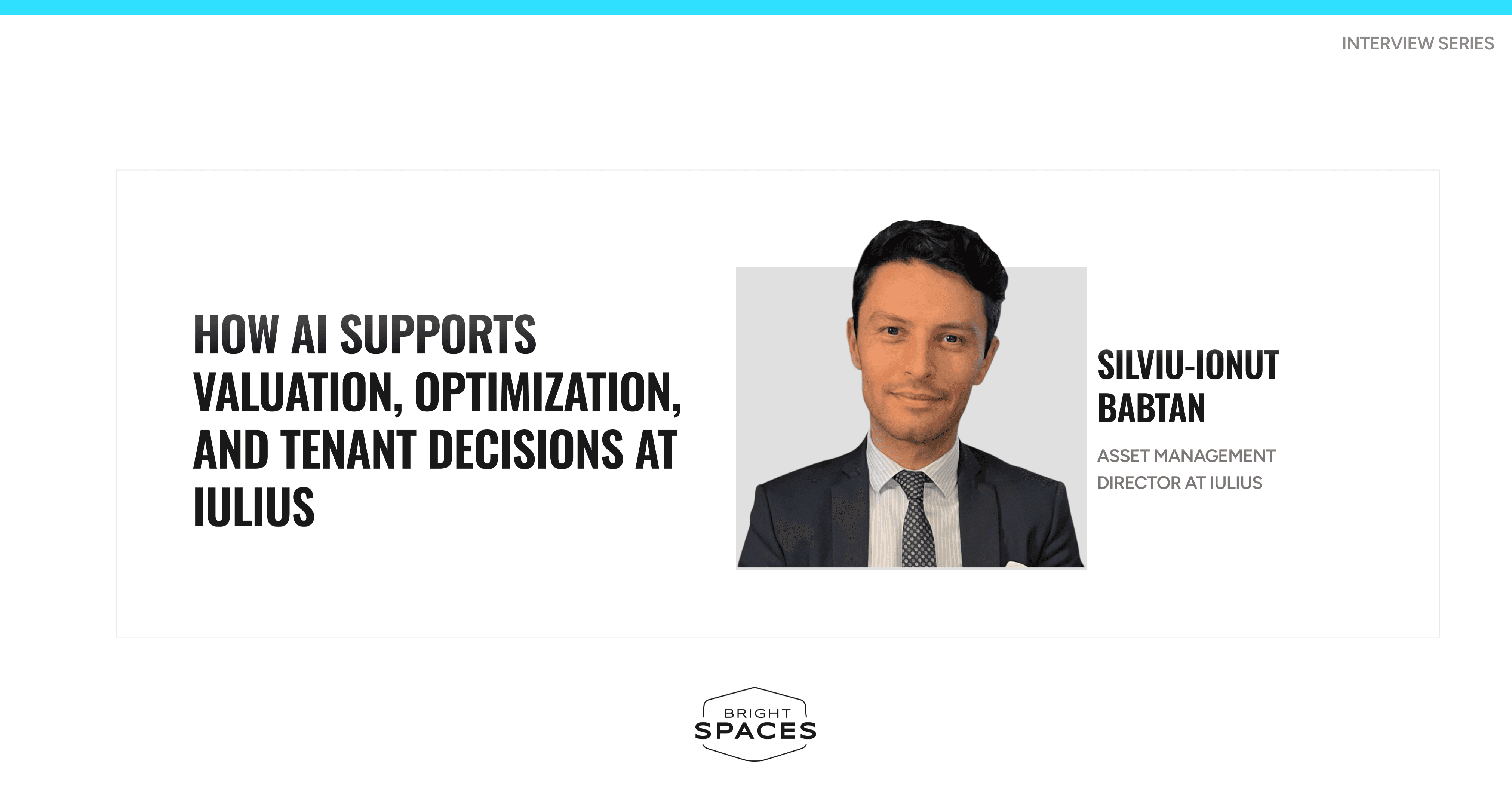
As AI starts to move from experimentation to real-world deployment in office real estate, few perspectives are as valuable as those coming directly from asset management.
In this interview, Silviu-Ionuț Băbţan shares how AI is already being applied across leasing and portfolio strategy at IULIUS, from behavioral analytics and pricing models to the operational realities of scaling AI across assets.
Working at the intersection of real estate and technology, Silviu combines hands-on asset management experience with academic research in Automated Valuation Models at Babeș-Bolyai University. This dual perspective allows him to approach AI not just as a concept, but as a practical tool for improving valuation, decision-making, and portfolio performance.
His insights offer a grounded view on where AI delivers real value today, what it takes to build trust at portfolio level, and how office buildings are evolving from static assets into adaptive, data-driven platforms.
Where do you see AI having the biggest potential impact today in office leasing or tenant decision-making?
AI already has a tangible impact across the entire leasing process, but its greatest value today lies in decision intelligence and space optimization.
From my perspective, there are two major directions:
Portfolio optimization at landlord level
At IULIUS, we are already using AI-driven solutions to move beyond simple footfall data towards behavioral analytics: dwell time, flows, conversion into individual retail units, heatmaps, and interactions between office and retail areas.
These insights allow us to identify underperforming zones, optimize tenant mix, and support leasing decisions based on real data rather than intuition.Valuation and pricing driven by machine learning
As part of my PhD research, I developed an Automated Valuation Model (AVM) using multiple algorithms (Linear Regression, Decision Trees, Random Forest, ANN, XGBoost).
Building on this, we are currently working on models that can predict rental levels for retail and office spaces, based on a structured set of variables and market indicators.
Overall, AI is transforming leasing from a reactive process into a predictive and data-driven strategy.
What would make you trust an AI-driven solution enough to use it across your portfolio?
We are already using AI solutions across our portfolio, particularly through our collaboration with AiVA and Bright Spaces, enabling behavioral analytics as described above.
Trust in AI at portfolio scale is built on three key pillars:
Accuracy and reliability of data
High accuracy levels (above 95%) are essential, along with redundancy mechanisms (such as local data storage in case of connectivity loss) and consistency across assets. Without this, AI remains just an attractive dashboard.Actionable insights, not just visualization
Many solutions stop at descriptive analytics. Real value comes when AI provides decision support: clear recommendations and predictive alerts for specific situations.Integration into operational workflows
AI must be embedded into real processes: leasing, asset management, KPI tracking, and budgeting.
Integration with CRM systems, leasing pipelines, and reporting tools is critical for adoption at scale.
Another important factor is transparency of logic—even if models are not fully explainable, decision-makers must understand them well enough to trust the outputs.
Do you see office space becoming more standardized or more customized in the future, and how could AI support that?
The future of office space will be a hybrid between standardization and hyper-customization, enabled by AI.
Standardization at infrastructure level
Buildings will provide a common foundation: smart systems, sensors, flexible layouts, and a digital infrastructure that enables data collection and integration.Customization as a competitive differentiator
The real differentiation will come from the ability to adapt space to tenant behavior.
AI will enable dynamic configuration of space, services, and even commercial terms, based on real usage patterns and organizational culture.
In this context, our partnership with Bright Spaces is highly relevant. Through the 3D digital mapping of office buildings—such as the upcoming Rivus project in Cluj-Napoca—we are enabling a new level of interaction between tenants and space, even before occupancy.
From our experience:
Through AI-driven solutions, we already understand how space is actually used, not just how it was designed.
This enables faster and more informed adjustments: reconfiguring zones, optimizing services, or even repositioning tenant mix.
In this context, office buildings will evolve from static products into adaptive platforms, where AI becomes a core layer in both operations and asset management strategy.
As AI starts to move from experimentation to real-world deployment in office real estate, few perspectives are as valuable as those coming directly from asset management.
In this interview, Silviu-Ionuț Băbţan shares how AI is already being applied across leasing and portfolio strategy at IULIUS, from behavioral analytics and pricing models to the operational realities of scaling AI across assets.
Working at the intersection of real estate and technology, Silviu combines hands-on asset management experience with academic research in Automated Valuation Models at Babeș-Bolyai University. This dual perspective allows him to approach AI not just as a concept, but as a practical tool for improving valuation, decision-making, and portfolio performance.
His insights offer a grounded view on where AI delivers real value today, what it takes to build trust at portfolio level, and how office buildings are evolving from static assets into adaptive, data-driven platforms.
Where do you see AI having the biggest potential impact today in office leasing or tenant decision-making?
AI already has a tangible impact across the entire leasing process, but its greatest value today lies in decision intelligence and space optimization.
From my perspective, there are two major directions:
Portfolio optimization at landlord level
At IULIUS, we are already using AI-driven solutions to move beyond simple footfall data towards behavioral analytics: dwell time, flows, conversion into individual retail units, heatmaps, and interactions between office and retail areas.
These insights allow us to identify underperforming zones, optimize tenant mix, and support leasing decisions based on real data rather than intuition.Valuation and pricing driven by machine learning
As part of my PhD research, I developed an Automated Valuation Model (AVM) using multiple algorithms (Linear Regression, Decision Trees, Random Forest, ANN, XGBoost).
Building on this, we are currently working on models that can predict rental levels for retail and office spaces, based on a structured set of variables and market indicators.
Overall, AI is transforming leasing from a reactive process into a predictive and data-driven strategy.
What would make you trust an AI-driven solution enough to use it across your portfolio?
We are already using AI solutions across our portfolio, particularly through our collaboration with AiVA and Bright Spaces, enabling behavioral analytics as described above.
Trust in AI at portfolio scale is built on three key pillars:
Accuracy and reliability of data
High accuracy levels (above 95%) are essential, along with redundancy mechanisms (such as local data storage in case of connectivity loss) and consistency across assets. Without this, AI remains just an attractive dashboard.Actionable insights, not just visualization
Many solutions stop at descriptive analytics. Real value comes when AI provides decision support: clear recommendations and predictive alerts for specific situations.Integration into operational workflows
AI must be embedded into real processes: leasing, asset management, KPI tracking, and budgeting.
Integration with CRM systems, leasing pipelines, and reporting tools is critical for adoption at scale.
Another important factor is transparency of logic—even if models are not fully explainable, decision-makers must understand them well enough to trust the outputs.
Do you see office space becoming more standardized or more customized in the future, and how could AI support that?
The future of office space will be a hybrid between standardization and hyper-customization, enabled by AI.
Standardization at infrastructure level
Buildings will provide a common foundation: smart systems, sensors, flexible layouts, and a digital infrastructure that enables data collection and integration.Customization as a competitive differentiator
The real differentiation will come from the ability to adapt space to tenant behavior.
AI will enable dynamic configuration of space, services, and even commercial terms, based on real usage patterns and organizational culture.
In this context, our partnership with Bright Spaces is highly relevant. Through the 3D digital mapping of office buildings—such as the upcoming Rivus project in Cluj-Napoca—we are enabling a new level of interaction between tenants and space, even before occupancy.
From our experience:
Through AI-driven solutions, we already understand how space is actually used, not just how it was designed.
This enables faster and more informed adjustments: reconfiguring zones, optimizing services, or even repositioning tenant mix.
In this context, office buildings will evolve from static products into adaptive platforms, where AI becomes a core layer in both operations and asset management strategy.
Product
© 2026 Bright Spaces. All rights reserved.
Product
© 2026 Bright Spaces. All rights reserved.
Product
© 2026 Bright Spaces. All rights reserved.